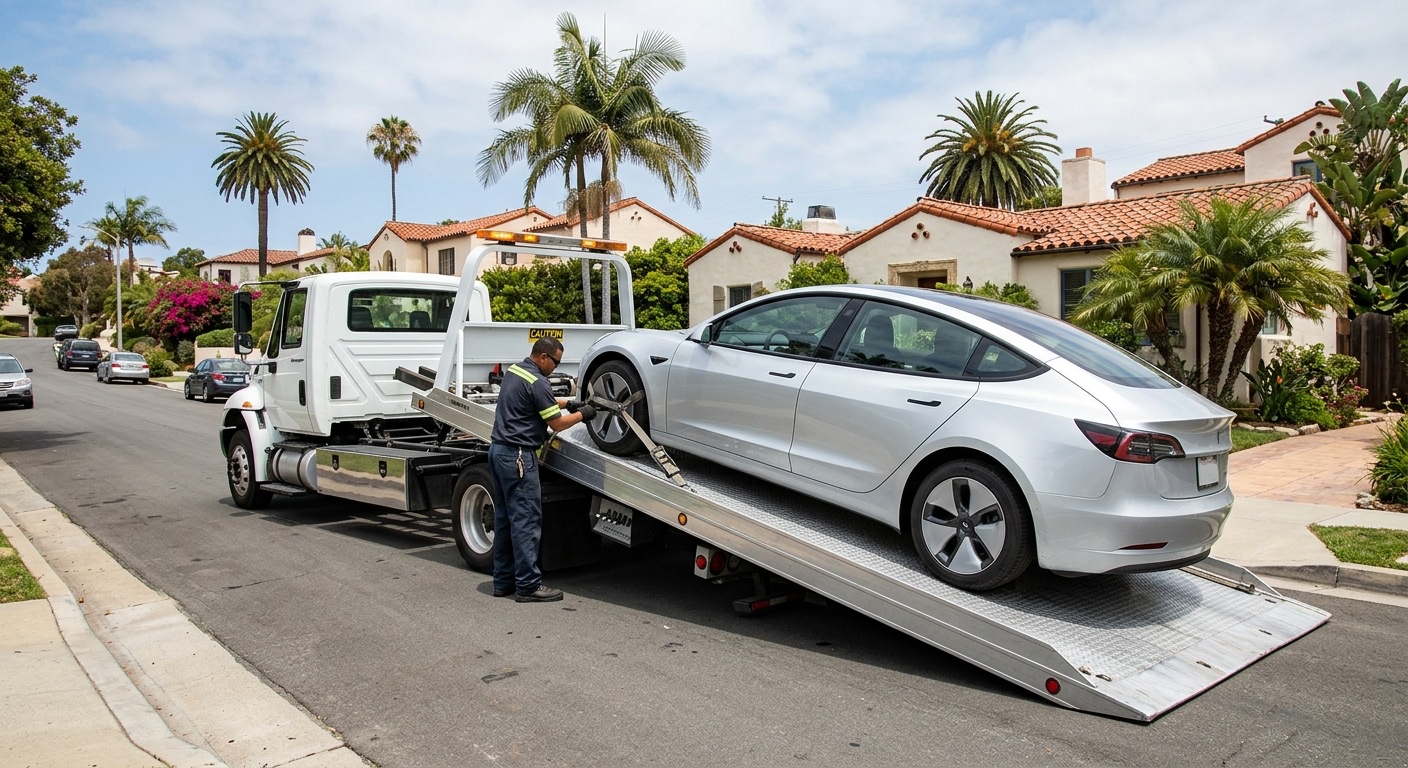
Every electric vehicle, whether it’s a Tesla, a Ford Mustang Mach-E, a Chevy Equinox EV, a Rivian, or any other EV on the road, needs flatbed towing. Wheel-lift towing, the kind that lifts the car by two of its wheels and tows it with the other two rolling on the pavement, can damage an EV’s drive motors and battery system even if the vehicle rolls and steers. That requirement shapes how a San Antonio EV tow gets dispatched and what you should ask for when you call.
Why every EV needs a flatbed
An EV’s drivetrain is fundamentally different from a gas-powered car. The electric motors that drive the wheels are tightly integrated with the axles, and they’re designed to deliver propulsion, not to free-wheel for long distances under tow. Spinning the drive wheels on a wheel-lift tow can induce current back into the motor and electronics, and can damage components that cost thousands of dollars to replace. The manufacturer guidance across the EV industry, including Tesla’s published move and tow procedures, treats flatbed-only transport as the safe method.
That guidance doesn’t change by city or county. There’s no San Antonio rule or Texas rule that makes wheel-lift towing acceptable for an EV. The flatbed requirement comes from the vehicle itself, and any operator that suggests a wheel-lift tow for an EV is signaling that they don’t have the equipment or the training to do the move safely.
What flatbed-only means in practice
For the operator, flatbed-only means dispatching a truck with a tilt-bed or a winch that can load a non-rolling vehicle. A Tesla that won’t power on can’t release its parking brake electronically, which means the wheels stay locked. The flatbed’s winch pulls the car up onto the deck, then straps and chains secure it for transport. A wheel-lift truck doesn’t have a winch, doesn’t have a deck, and can’t safely load an EV that’s in a non-running state.
For the driver, flatbed-only means the price of the tow is generally a little higher than a basic wheel-lift job, because flatbed equipment costs more to run and the move takes a few extra minutes. For a consent tow you arrange yourself, the operator quotes the job based on distance, vehicle type, and equipment. For a non-consent tow, San Antonio’s city caps under § 19-402 don’t apply to consent moves, and the operator’s published rate is what you’ll be quoted.
San Antonio corridors and EV tow routes
San Antonio sits at the convergence of three major interstate corridors, and the one your EV is on when it needs a tow shapes the response.
I-35 north is the busiest of the three for EV traffic, especially commuter traffic heading up toward Austin. A breakdown on I-35 between Selma and New Braunfels typically means a tow to a Tesla-approved service center or a third-party EV-capable shop, depending on the year and model. Operators running this corridor regularly know the difference between Tesla’s own service network and general EV repair shops.
I-10 east and west carries a mix of commuter and Hill Country traffic. A tow from Boerne or Fair Oaks Ranch back into San Antonio is a typical westbound move, and operators running that route have set prices for it. Eastbound, the corridor reaches Seguin and Houston.
US-281 north through Stone Oak carries 91,000+ vehicles a day, and high-volume corridors see more EV breakdowns simply because more vehicles use them. A Stone Oak tow to a service center is a routine move for operators who run that corridor.
Loop 1604 and Loop 410 carry the bulk of in-city EV traffic. A flatbed from a Loop 1604 shoulder into a service center is a 20- to 40-minute move, depending on the destination.
Tesla service routing in San Antonio
Tesla operates its own service center network, and the local service center handles most warranty and collision work for San Antonio Tesla owners. For a non-collision tow, like a roadside mechanical issue, Tesla’s roadside assistance typically dispatches a flatbed directly. If you call Tesla first and the issue is covered, their team handles the move end to end.
If you call a third-party tow first, the operator needs to know the destination. Tesla’s service center is the right destination for warranty and recall work, but a third-party EV-certified shop is often faster for out-of-warranty repairs. Some operators will ask which destination you want before dispatching.
For non-Tesla EVs, the manufacturer roadside program typically dispatches a flatbed directly. Ford, GM, Rivian, Hyundai, and the other major EV-makers all have published roadside procedures that require flatbed transport. If you’re not sure whether your manufacturer program covers roadside towing, the answer for almost every EV on the road in 2026 is yes.
What to do if your EV needs a tow in San Antonio
Before the truck arrives, put the vehicle in tow mode if it still has power. Tesla and most EVs have a tow mode setting that releases the parking brake electronically and lets the car roll a short distance under its own power. Activating that mode makes loading easier and avoids winching stress on the parking brake.
If the vehicle has no power at all, the operator will winch it onto the flatbed. Make sure the parking brake is engaged and the wheels are chocked before the truck arrives. If you can do it safely, leave the key or key card in the vehicle so the operator can power up accessories or move the seats if needed.
When you call, have these details ready: your location, the year/make/model of the EV, whether it has power and can roll, whether it’s been in a collision, and where you want it taken. A flatbed operator with EV experience will quote the move based on those details.
Why training matters more than equipment
A flatbed truck isn’t hard to find in San Antonio. EV experience is. The operator should know how to load a non-rolling EV without dragging it, where to position the winch strap, and how to secure a heavy battery pack for transport. Ask the operator if they have specific EV experience before they dispatch. Most licensed operators in the San Antonio towing market have moved EVs at this point, but a quick confirmation saves a learning curve on the side of the road.
Related reading
For what to do before any tow, see how to get a tow truck near you in San Antonio. For long-distance EV moves out of the city, read long-distance tow cost from San Antonio.
Frequently asked questions
Can an EV be towed with a wheel-lift truck? No. Wheel-lift towing on an EV can damage the drive motors and battery electronics. Every EV manufacturer requires flatbed-only transport.
Does Tesla have its own roadside assistance in San Antonio? Yes. Tesla roadside dispatches a flatbed directly for most mechanical issues, and the local Tesla service center handles warranty and collision work.
How much does it cost to flatbed an EV in San Antonio? The operator quotes the job based on distance, vehicle type, and equipment. San Antonio’s § 19-402 caps apply to non-consent tows only. A flatbed for an EV costs a little more than a wheel-lift because the equipment is heavier and the move takes longer.
Do I have to put my Tesla in tow mode before the truck arrives? If the vehicle still has power, yes. Tow mode releases the parking brake and lets the car roll a short distance, which makes loading easier and avoids stressing the brake.
Can any flatbed operator tow my EV? Most licensed operators in San Antonio have moved EVs and can handle the move. Ask if they have specific EV experience before they dispatch, especially if your vehicle is non-rolling or in a collision.
Where should my EV be taken after a tow? For Tesla, the local Tesla service center handles warranty and collision work. For other EVs, the manufacturer roadside program typically specifies an EV-certified shop. Some operators will ask which destination you want before dispatching.