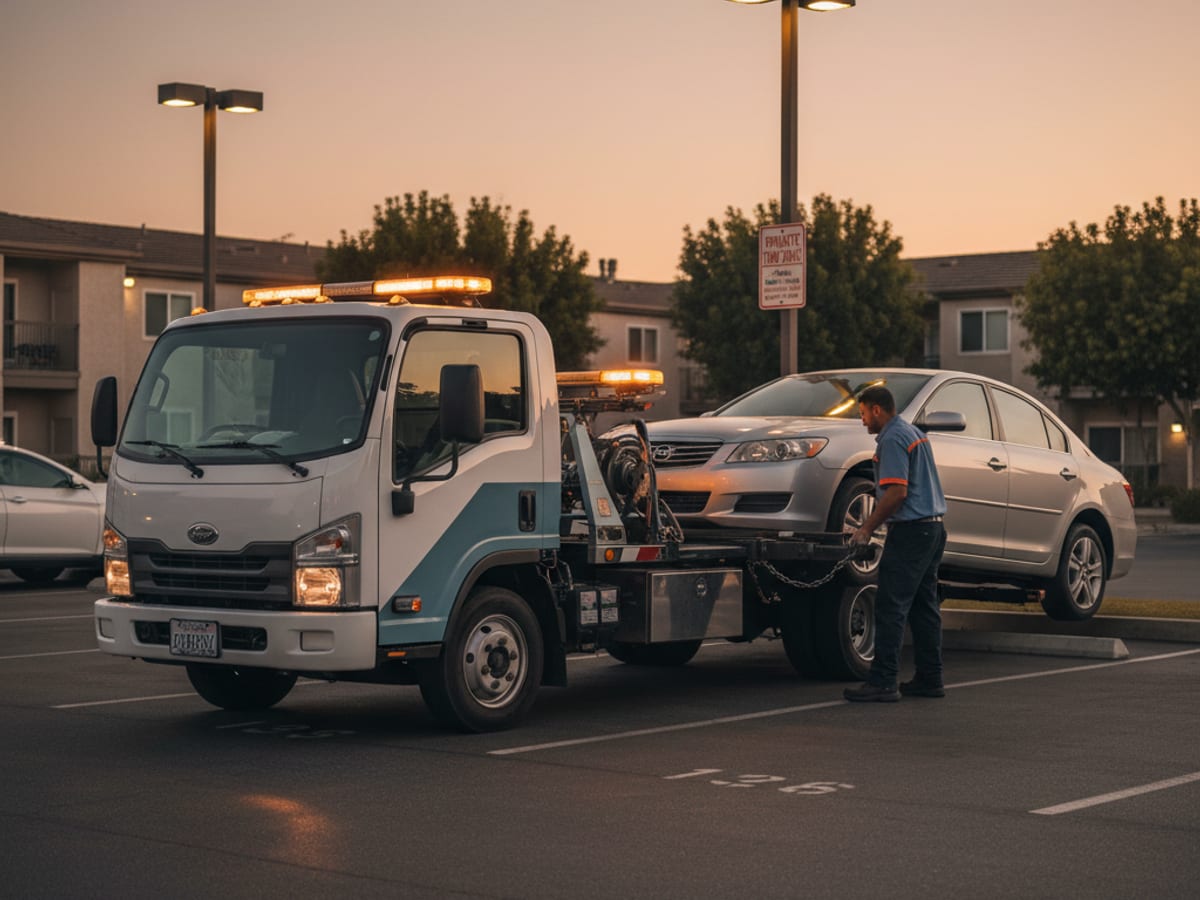
Someone parked in your assigned spot, and now you can’t park in your own driveway, lot, or reserved stall. Most reserved-spot disputes get resolved on-site without a tow, but if the property owner or manager needs to remove the vehicle, San Antonio’s signage rules under City Code § 19-391 have to be in place first. Here’s what works for homeowners, tenants, and HOA-managed properties in the city.
Try the easy path first
Before anyone calls a tow truck, walk over and talk to the driver. Most reserved-spot problems happen because someone pulled into the wrong stall, didn’t see the number, or thought the lot was open. A quick conversation, “Hey, this is my spot, I’m in 4B,” usually ends with the car moving and no tow needed.
If the driver isn’t around, leave a polite note on the windshield with your unit or stall number and a request to move. That alone resolves most one-time mix-ups without escalating.
If it’s a repeat problem
Some properties get repeat offenders, especially in dense neighborhoods, near event venues, or around apartment complexes. If you’re dealing with a one-time mistake, the conversation and note approach covers it. If you’re dealing with a car that keeps coming back to the same reserved spot, the property owner or manager needs to escalate.
For an apartment or HOA-managed property, that escalation goes through the leasing office or the property manager. They have the authority to authorize a tow under the lot’s published rules, but only if the property’s signage meets the city ordinance. Without proper signage, the tow isn’t enforceable, and a licensed operator will generally refuse to take the vehicle.
The signage requirement under § 19-391
San Antonio City Code § 19-391 is what governs private-property towing in the city. To lawfully tow from a private lot, the property has to post at least one sign at each driveway or curb-cut entrance. That sign is the first thing you see when entering, not something tucked behind a dumpster or near the back fence.
Inside the lot, any restricted or reserved area, including reserved tenant spots, handicap spaces, fire lanes, and visitor parking, needs its own signage marked at intervals no more than 50 feet apart. A single sign at the entrance doesn’t cover a reserved row halfway across the property. The ordinance wants a driver to be able to see a sign no matter where they park.
Dumpster access areas have their own rule. Those signs have to read “NO PARKING-TOW AWAY ZONE” in letters at least 3 inches tall, in a color that contrasts with the background.
If a property doesn’t meet the signage rule, a towing company generally won’t take the vehicle, because the tow wouldn’t be enforceable. That’s the leverage a property manager has, but it’s leverage that requires the signs to be up first.
Who can authorize the tow
A property owner or their agent, which includes an apartment property manager and most HOA boards, can authorize a tow from their own lot. The tow has to be performed by a TDLR-licensed operator under Occupations Code Chapter 2308, the Texas Towing and Booting Act. A property manager can’t wave down any truck with a hook and call it legal.
There’s also a hard line between private lots and public streets. A property owner can authorize a tow from their own lot, but a tow from a public street can only be ordered by the San Antonio Police Department. If your spot is on a public street and someone keeps parking there, that’s a SAPD matter, not a private tow.
The apartment-specific wrinkle
Texas law adds a specific protection for tenants. Under House Bill 560, an apartment complex cannot tow a vehicle merely because its registration or inspection sticker is expired. Towing in an apartment context is limited to real obstructions, tow-away zones, oversized vehicles, and dangerous fluid leaks. A reserved-spot violation is a real towable offense, but the apartment can’t tack on registration or inspection as a separate reason.
For a tenant dealing with someone in their assigned spot, this means the dispute is about the parking violation itself, not about anything else the car may or may not have on it.
What to ask before the truck shows up
For a property owner or manager about to authorize a tow, three questions matter:
- Is the signage in place and visible? If not, fix that first. A tow without proper signage is unenforceable and creates a dispute later.
- Is the operator licensed through TDLR? An unlicensed operator isn’t lawful under the Texas Towing and Booting Act, and the tow ticket won’t stand up.
- Has the operator given a written quote? A legitimate operator quotes the job before the truck rolls, and the property gets a tow ticket that itemizes every charge.
For a tenant whose car was towed from a reserved spot, the same questions apply in reverse. Was the lot properly signed? Was the operator licensed? Does the tow ticket reference the specific violation? Those are the bases for a dispute if the tow turns out to have been improper.
When it’s a SAPD matter
If the offending car is parked on a public street in your reserved space, the public-street-versus-private-property line kicks in. Call SAPD’s non-emergency line at (210) 207-7273, give them your address, and explain that someone is repeatedly parking in a reserved space. A dispatcher will tell you what happens next. You cannot have a private tow truck remove a car parked on a public street just because it’s in your spot.
Related reading
For what the city requires of any private-property tow, see private property towing sign requirements in Texas. For getting your car back after a tow, read how to get a car out of impound in San Antonio.
Frequently asked questions
Can my apartment tow a car parked in my reserved spot? Yes, if the lot has the proper signage under City Code § 19-391 and the operator is licensed through TDLR. The reserved-spot violation is a real towable offense under Texas law.
Can a complex tow me for an expired registration sticker in Texas? No. House Bill 560 specifically prohibits towing from an apartment complex solely because the registration or inspection sticker is expired. Towing is limited to real violations like reserved-spot, fire lane, oversized vehicle, or dangerous leak.
What if the property doesn’t have the right signs? Without signage meeting § 19-391, a tow isn’t enforceable and a licensed operator will generally refuse to take the vehicle. The property owner should fix the signage before authorizing any tow.
Can I have a private tow truck remove a car from a public street in my spot? No. Only SAPD can order a tow from a public street. Call the non-emergency line at (210) 207-7273.
Who pays for the tow when an unauthorized car is removed from a reserved spot? The owner of the towed vehicle pays the tow and storage fees, not the property owner. The tow operator collects at the yard, following the published fee schedule.
How far apart do the signs need to be in a big lot? Restricted or reserved areas need signage at intervals no more than 50 feet apart under § 19-391. A single sign at the entrance doesn’t cover a reserved row halfway across the property.