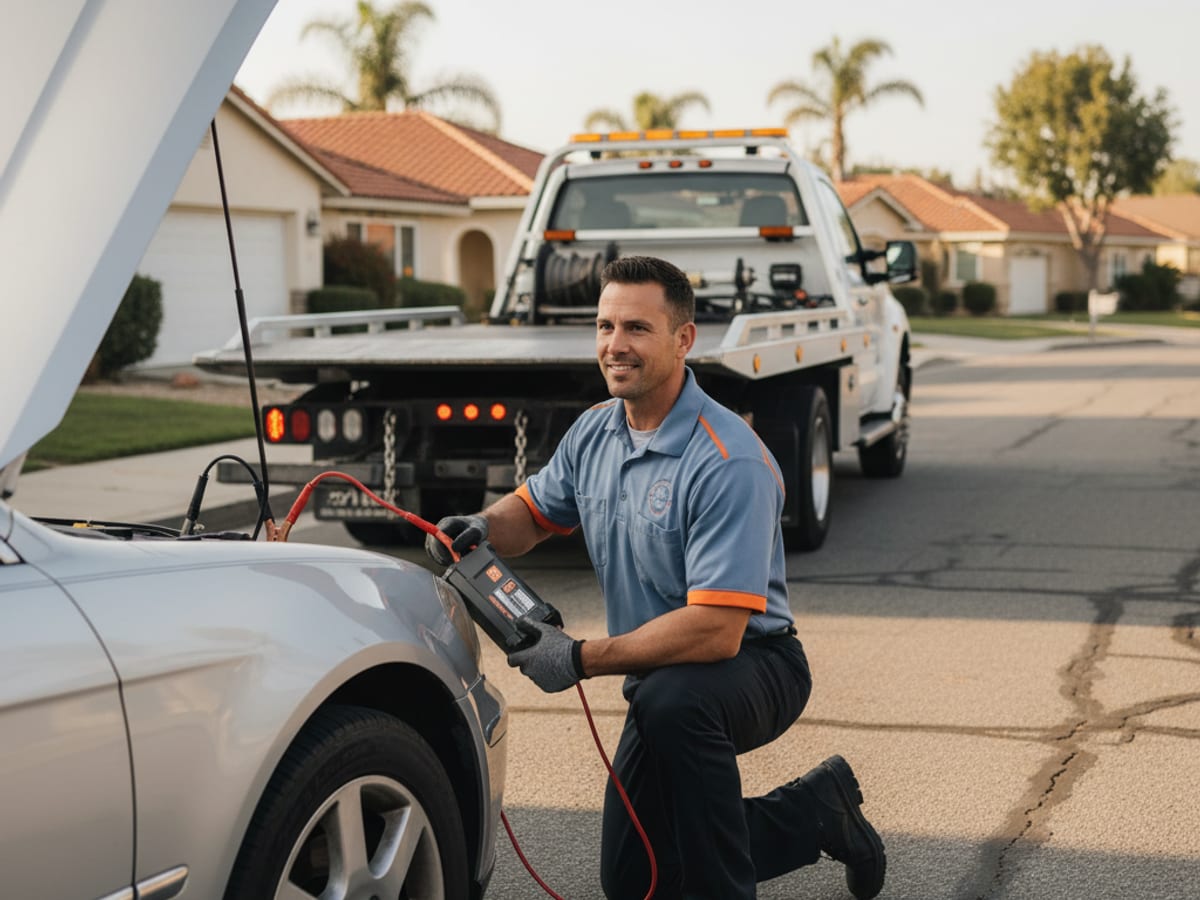
If you’re locked out, your battery is dead, you ran out of gas, or you have a flat on the shoulder of I-35, you don’t need a roadside membership to get help. Pay-per-call roadside service is widely available in San Antonio, and the operator quotes the specific job before any work happens. Here’s what each service typically covers, what it costs in general terms, and how to call it.
What pay-per-call roadside actually does
A licensed roadside operator in San Antonio handles four main jobs without needing a membership:
- Jump start for a dead battery, getting your car running again so you can drive to a shop for a replacement.
- Flat tire change if you have a usable spare and the flat is on a wheel the lug pattern can handle.
- Fuel delivery for an out-of-gas situation, typically enough to get you to the nearest station.
- Lockout for keys locked inside the car, using non-damaging entry tools rather than forcing the door.
Each of these is a discrete job with a discrete price. The operator quotes it before rolling out, and the total reflects the distance to your location plus the type of work, not a membership fee or an annual contract.
Why this matters in San Antonio
San Antonio’s three main interstate corridors, I-35, I-10, and I-37, plus the busy loops (Loop 410 and Loop 1604) and high-volume arterials like US-281 through Stone Oak, generate a steady stream of roadside incidents. Hot summers, with highs above 100°F, push battery failures up sharply from June through September. The February 2021 freeze, when San Antonio stayed below 32°F for 107 straight hours, was a multi-day roadside event by itself, with around 700 accidents and tens of thousands of calls for help.
A pay-per-call service gets you help on any of those days without needing to remember to renew a membership or pre-pay for coverage you might not use. For occasional drivers, recent transplants, or anyone whose existing membership has lapsed, that’s the practical path.
How the pricing works
There are two parts to a pay-per-call invoice. The first is a service-call fee that covers the operator’s trip to your location. That fee varies by distance and time of day. The second is the work itself, which is a flat rate for the specific job. A jump start costs less than a lockout, which costs less than a fuel delivery that requires the operator to leave and come back.
Operators quote the total before they roll, so you’re not guessing. Some operators quote the service-call fee first and the job price once they’re on scene and have confirmed the work needed, which is fine as long as the second number is also given before any tools come out.
What to have ready when you call
Before you call an operator, have these details ready:
- Your location, ideally a specific address, an exit number, or a landmark near you. On the highway, the nearest cross street or mile marker helps the operator find you faster.
- The vehicle year, make, and model.
- The specific problem: dead battery, flat tire, out of fuel, locked out, or something else.
- Whether you’re in a safe spot to wait, off the travel lane, on a shoulder, or in a parking lot. If you’re stranded in a live traffic lane, that changes the dispatch priority.
For highway incidents, position yourself as far from traffic as possible, turn on your hazard lights, and stay in or near the vehicle unless staying in the vehicle is itself dangerous. Texas Department of Transportation guidelines for stranded motorists favor staying with the vehicle on most highway shoulders.
The lockout case in particular
Lockouts are the most common pay-per-call job in any major metro, and San Antonio is no different. A skilled operator can open most vehicles in a few minutes without damaging the door, the lock, or the window seal. The work typically costs more than a jump start because the tools and the training take longer to develop, and the job is sensitive, since an inexperienced operator can break a window trying.
When you call for a lockout, ask the operator what year, make, and model they have experience with. Newer vehicles with electronic locks and key-fob authentication sometimes need different tools than older mechanical locks. An honest operator will tell you if they have experience with your specific vehicle.
The fuel delivery case
Out-of-gas situations in San Antonio usually happen on the highways, where the next gas station may be ten miles away. A pay-per-call operator can bring a few gallons of fuel to your location, enough to get you to a station. The fuel is part of the cost, and the operator should quote both the fuel charge and the service-call fee before they roll.
If you find yourself out of gas on a less-traveled road or in a part of the city you don’t know well, the operator will likely ask for a landmark or a cross street to find you. Highway service is faster because the operator knows the corridor.
When the right call is a tow instead
A roadside service has limits. A jump start only helps if the battery is the actual problem. A flat tire change only helps if you have a usable spare. If your car is mechanically beyond a roadside fix, the operator will tell you, and the right move becomes a tow to a shop.
For a tow from a San Antonio corridor into a shop, see how to get a tow truck near you in San Antonio. For what to do when the car is non-running and you need a recovery, see our accident recovery service page.
Related reading
For the consent-tow path when a roadside fix isn’t enough, see tow truck near me in San Antonio. For what published fee caps apply if your car ends up at the city lot, see how to get a car out of impound in San Antonio.
Frequently asked questions
Do I need a roadside membership to get a jump in San Antonio? No. Pay-per-call operators handle jump starts, lockouts, tire changes, and fuel delivery without a membership. The operator quotes the job before rolling out.
How much does a jump start cost without AAA? The operator quotes a service-call fee plus the job price. The total varies by location, time of day, and operator. A legitimate operator gives you the number before dispatch.
Can a roadside operator open a locked car without damage? Yes. A skilled operator uses non-damaging entry tools and can open most vehicles in a few minutes. Ask the operator about experience with your specific year, make, and model before dispatch.
What if I’m out of gas on the highway? A pay-per-call operator can bring a few gallons of fuel to your location. Quote includes the fuel charge and the service-call fee.
Can roadside fix a flat tire? A roadside operator can change to your spare if you have one and the lug pattern fits. If you don’t have a usable spare, the right call is a tow to a tire shop.
Is pay-per-call roadside more expensive than a membership? Per incident, pay-per-call is usually more expensive than a single membership call. Per year, pay-per-call often costs less for occasional drivers than an annual membership they don’t fully use.